
There’s a moment, and if you’ve spent serious time working with AI tools in the past two years you’ll recognize it, where something clicks and you realize you’ve stopped using AI as a tool and started thinking through it. The query-response loop becomes less like typing into a search engine and more like having a conversation with a weirdly capable colleague who never sleeps, never has a bad day, and has read more than any human alive.
For most people, that moment passes without comment. They close the tab, write their email, ship their code. But something has changed underneath. A small tectonic shift in how work actually happens. The workflow didn’t just get faster. It got different.
This is what “AI-native” means, and it’s a more radical idea than most organizations are ready to admit. Not AI-assisted. Not AI-augmented. AI-native. Where the process itself is designed from the ground up with AI as a first-class participant, not a bolt-on feature. It’s the difference between a horse-drawn carriage with a motor strapped to it and an internal combustion engine built into a purpose-designed car. Same destination, completely different machine.
We are, right now, in the middle of a messy, thrilling, disorienting transition from one kind of work to another. Some people see it clearly. Most are still figuring it out. And the organizations that understand what’s actually happening, versus the ones running AI pilots and calling it transformation, are going to look very different from each other in about three years.
Let’s talk about what’s really going on…
Before we can understand why AI-native workflows matter, we need to be honest about the thing they’re replacing.
The modern knowledge worker’s day is, frankly, a disaster of cognitive overhead. Not because people are lazy or inefficient. Most of the professionals I’ve observed are genuinely trying hard. The problem is that the tools and processes they use were designed for a world that no longer exists. Email was built for asynchronous communication between small groups. It became the universal inbox for everything from customer escalations to party invites to passive-aggressive CC threads. Spreadsheets were built for accountants and financial analysts. They became the default database for half the world’s business logic. Slack was built to reduce email. It became email, but louder.
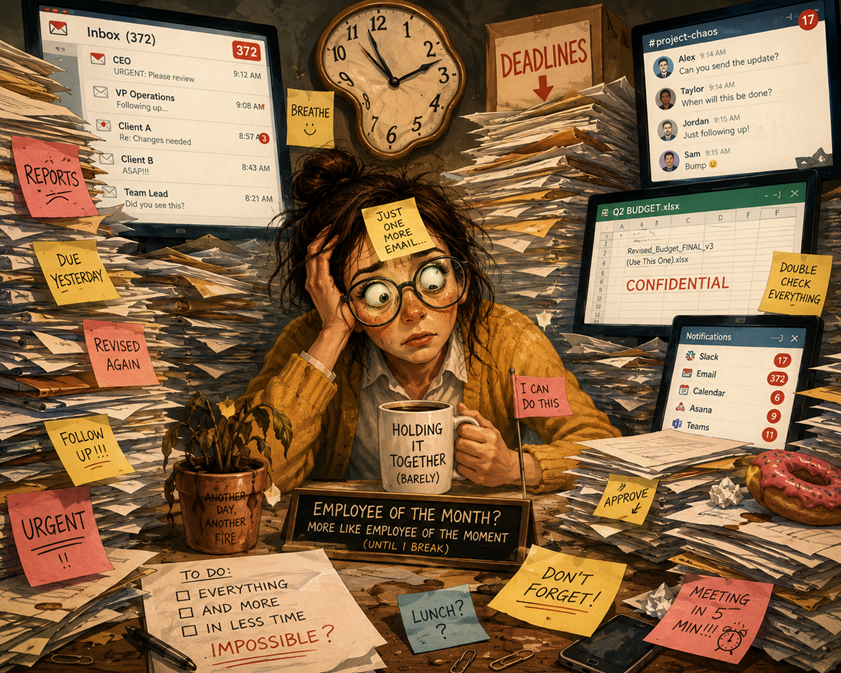
The result? Knowledge workers spend enormous chunks of their day not doing the thing they were hired to do, but managing the scaffolding around it. Searching for the document someone mentioned on a call last Tuesday. Reformatting data from one system to paste it into another. Writing a summary of a meeting so it can live in a folder nobody reads. A 2023 study from Asana found that workers spend about 58% of their time on what the researchers called “work about work.” Meta-tasks that exist only to support the actual work, producing no direct value themselves.
Into this bloated, slightly dysfunctional world walked large language models. And here’s where it gets interesting: the first instinct of most companies was to use AI to do the work-about-work faster. Summarize the meeting notes automatically. Draft the email response. Generate the first version of the report. Which is useful, no question. A genuine time-saver. But it’s also, in a deep sense, a missed diagnosis. You’ve made the scaffolding more efficient, but you haven’t questioned whether the scaffolding should exist.
AI-native workflows ask a more uncomfortable question. What if we redesigned the process entirely, assuming AI capabilities exist from the start?
That question has a very different answer than “how can we use AI to speed up what we already do.“
The word “native” is doing a lot of work here, so let’s be precise about it.
When developers talk about “cloud-native” applications, they don’t mean apps that run on a server somewhere in the sky. They mean applications designed with cloud properties as core assumptions. Elasticity, distributed architecture, statelessness baked in from day one. A cloud-native app behaves fundamentally differently from a legacy app that’s been lifted and shifted onto AWS. It scales differently, it fails differently, it’s developed differently.
AI-native workflows are analogous. They’re not workflows that happen to use AI tools. They’re workflows designed with AI capabilities as baseline assumptions, where the human’s role, the decision points, the information flows, and the outputs are all structured around what becomes possible when you have a highly capable reasoning system available at every step.
The unit of work shifts. In a traditional workflow, a human performs a discrete task, produces an output, and passes it to the next person or stage. In an AI-native workflow, the human more often defines the objective and evaluates the output, while AI handles much of the execution. The human role migrates up the stack. From doer to director, from operator to editor.
Context becomes the key resource. Traditional workflows manage time, meaning who does what and when, and information, meaning who has access to what. AI-native workflows add a third resource: context. The rich, accumulated understanding of goals, constraints, history, and nuance that allows an AI system to produce genuinely useful output rather than generic content. Teams that get good at building and maintaining context for their AI systems gain a compounding advantage. Teams that treat every AI interaction as a fresh blank slate leave most of the value on the table.
Iteration replaces specification. Legacy workflows often front-load design. You write the brief, create the spec, hold the kickoff meeting, and then execute. The cost of changing direction mid-flight is high, so you try to get it right upfront. AI-native workflows invert this. Because AI can generate plausible first drafts, prototypes, and explorations almost instantly, the most effective approach is often to start moving and steer as you go. The brief emerges from the conversation, not before it.
This isn’t just philosophical. It changes how teams are structured, how projects are scoped, and how individuals develop their skills. Which is why the organizations taking AI-native design seriously are rebuilding their processes differently, and why the organizations simply deploying AI tools without rethinking process are generating a lot of noise without much signal.
If you’ve been inside enough companies navigating AI adoption, and I have, from scrappy startups to large enterprises running cautious pilots, you start to see a pattern. Most organizations cluster into one of three meaningfully different tiers, and the distance between Tier 1 and Tier 3 is larger than most executives realize.
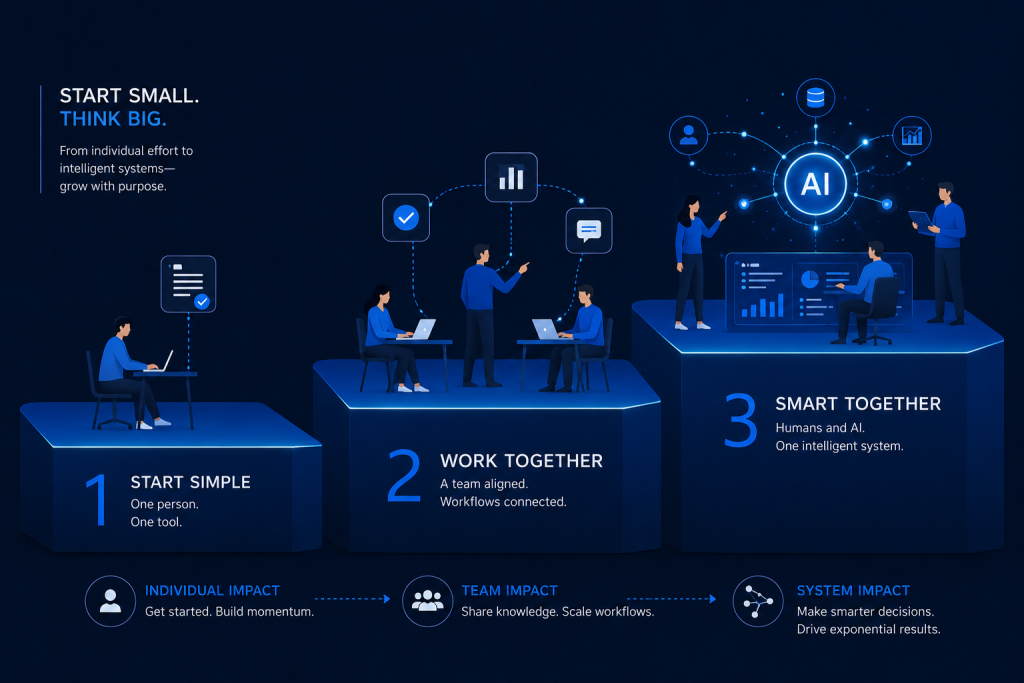
The leap from Tier 2 to Tier 3 is the hard one, and it’s not primarily a technology problem. It’s an organizational design problem, a change management problem, and honestly a psychological problem too. Because AI-native design requires acknowledging that some roles, processes, and entire departments need to be rebuilt from scratch, not just upgraded.
Most companies avoid that conversation. They run AI pilots, declare success, roll out Microsoft 365 Copilot to 50,000 employees, and call it AI transformation. It isn’t. It’s Tier 1 at enterprise scale.
Here’s a question worth sitting with. If AI can write the first draft, analyze the data, summarize the meeting, review the contract, and generate the code, what exactly is the human doing?
It’s the question that makes a lot of people uncomfortable, including some who work in AI. But it’s the wrong question, or at least it’s framed wrong. The better question is: what does the human do better because AI is handling everything else?
The answer, it turns out, is quite a lot. Just not the same things.
In AI-native workflows, the human role concentrates around a handful of genuinely hard capabilities that current AI systems don’t do well and may not do well for a long time. Judgment under ambiguity, where the right answer depends on context, relationships, organizational history, and unstated values that can’t be fully specified in a prompt. Accountability, meaning the willingness to put your name on something and own the consequences. Taste, the ability to recognize quality not just technically but aesthetically and strategically. And trust, the social and relational work of persuading other humans to believe in something, which still requires a human face.
Notice what’s not on that list. Formatting documents. Writing boilerplate. Searching for information. First-pass editing. Generating options. Translating between formats. Scheduling and coordination. Research synthesis. These tasks, which collectively eat an enormous portion of a knowledge worker’s week, are exactly where AI performs well. And in AI-native workflows, they get offloaded almost entirely.
The result is a role that looks less like traditional “doing” and more like what used to be called senior judgment. The kind of work that previously only happened at the top of an organization, where people set direction, make calls, and take responsibility, now needs to happen at every level. Which is both an opportunity and a genuine challenge, because not everyone is trained for it, and not everyone wants it.
There’s also a skill that doesn’t get talked about enough in these discussions: the ability to work with AI effectively. This is not a trivial thing. The difference between someone who gets mediocre output from a large language model and someone who gets extraordinary output is not, primarily, a difference in access to better tools. It’s a difference in how they think about framing problems, how much context they provide, how they iterate on outputs, and how critically they evaluate what comes back. These are learnable skills, but they’re not automatic, and organizations that treat them as automatic are consistently disappointed by their AI results.
The new literacy isn’t coding. It’s not even “prompt engineering,” which has always been a slightly misleading term. It’s something more like collaborative thinking with AI, the ability to have a productive back-and-forth with a system that is very capable but has no inherent understanding of what you actually need. The people who are genuinely excellent at this tend to be people who are clear thinkers, good writers, and intellectually comfortable with iteration. Which, not coincidentally, are the same people who tend to be excellent at working with other humans.

Theory is useful, but let’s get specific. Because AI-native workflows aren’t a future scenario. They’re happening right now, in real organizations, and the patterns are instructive.
A mid-sized B2B software company I’m familiar with restructured its entire content operation around two people and a set of AI workflows. Previously, they had a content team of nine, producing a reasonable volume of blog posts, case studies, email sequences, and sales enablement material. After an honest assessment of where human effort was actually adding value, they rebuilt the operation from scratch. The two humans now handle strategy, editorial direction, brand voice maintenance, subject matter interviews, and final quality review. Everything in between, research, outlining, first drafts, SEO optimization, formatting, internal distribution, is handled through a combination of AI tools and lightweight automation. Output volume went up. Quality, by their own metrics and customer feedback, held steady or improved. The cost reduction was dramatic, but that’s almost a side effect. The more important thing is that the two people remaining are doing work they actually find meaningful, which is the strategic and creative judgment work, rather than the production work they used to dread.
This is becoming a real pattern in professional services. Individual practitioners, lawyers, consultants, financial advisors, are using AI-native workflows to handle caseloads or client portfolios that would previously have required teams. A solo employment lawyer in the US described her practice to me in terms that would have sounded like science fiction five years ago. She uses AI for initial case assessment, legal research, first-draft motions and briefs, client intake documentation, and correspondence. She handles strategy, client relationships, court appearances, and the judgment calls that genuinely require legal expertise and accountability. Her billing rate has gone up. Her case volume has gone up. Her stress level, by her account, has gone down, because she’s spending more time on the parts of law she went to law school for.
Some engineering teams are now operating in ways that the broader industry is still catching up to. Not just using GitHub Copilot to autocomplete code, but running AI-native development processes where AI handles first implementations of well-specified features, test generation, documentation, code review checklists, and debugging assistance on known error patterns. The human engineers focus on architecture decisions, system design, complex debugging, stakeholder translation (turning product requirements into technical specifications), and code review for logic and security rather than style and boilerplate. These teams are not necessarily producing perfect software. But they’re making meaningful decisions and shipping working products at speeds that have real competitive implications.
A policy research organization rebuilt its intelligence-gathering workflow around the recognition that the expensive, time-consuming part of research, the initial literature review, the synthesis of existing work, the identification of gaps and contradictions, was exactly where AI could do significant heavy lifting. Human researchers now spend far less time reading documents and far more time conducting original interviews, making sense of conflicting evidence, and writing the analytical pieces that require genuine expertise. The research director described it as giving every researcher a very fast, very thorough assistant who never gets tired of reading PDFs.
These examples share a common thread. In each case, the organization didn’t just add AI tools to existing processes. They asked which parts of the work genuinely required human judgment and which parts were, effectively, cognitive labor that could be automated, and then they redesigned around that distinction.
If AI-native workflows are so clearly valuable, why aren’t more organizations doing this? The technology is accessible. The tools are improving fast. The cost is, in most cases, a small fraction of the labor costs being replaced or redeployed.
The answer is that the transition is, in most organizations, a human problem. Several human problems, actually, layered on top of each other.
This is partly why outside perspectives, whether from consultants, from peer organizations, or from the increasingly rich body of case studies being published about AI-native transitions, are so valuable. Not because outsiders know your business better than you do, but because they don’t carry the cognitive weight of “how things have always been done.”
One of the underappreciated dynamics in AI-native workflows is the role of accumulated context, and how quickly it becomes a genuine competitive advantage.

Here’s what I mean. A large language model, on its own, knows a lot of general things. It can write, reason, summarize, and analyze across a huge range of topics. But it doesn’t know your organization. It doesn’t know your customers, your brand voice, your past decisions and why they were made, your internal terminology, the specific competitive dynamics of your market, or the thousand small contextual details that separate generic good work from work that’s actually right for your situation.
The organizations that are pulling ahead in AI-native workflows are, almost universally, the ones that have figured out how to build and maintain rich context for their AI systems. This takes different forms. Comprehensive system prompts and AI personas that encode brand voice and behavioral guidelines. Internal knowledge bases that AI can reference when answering questions or generating content. Structured repositories of past work that provide examples and standards. Feedback loops that capture when AI output was good or bad and why.
Building this kind of context infrastructure is not glamorous work. It requires someone to sit down and articulate things that have always been implicit, to write down the judgment calls that experienced people make automatically without thinking about how they make them. It requires ongoing maintenance as the organization evolves. And it requires genuine investment of time and attention from people who are already busy.
But the payoff is compounding in a way that’s genuinely striking. An organization with six months of well-maintained context infrastructure gets substantially better output from the same AI tools than an organization starting cold. After a year, the gap is significant. After two years, it starts to look like a moat, because the context that’s been built reflects not just general knowledge but specifically accumulated organizational knowledge that a competitor can’t simply replicate by buying the same tools.
This is, in a sense, a new kind of institutional knowledge. The kind that used to live in people’s heads and walked out the door when they left is now, if you’re deliberate about it, being captured and made accessible in ways that make the organization smarter over time rather than dependent on specific individuals.
It’s worth being concrete about where AI-native workflows are having the most immediate impact, because it’s not evenly distributed and the patterns are telling.
This industry is moving faster than their reputation for conservatism would suggest. The economics are compelling: legal work is expensive, much of it is structurally repetitive even if intellectually complex, and clients are increasingly unwilling to pay premium rates for work that AI can do well. Law firms that figure out AI-native workflows reduce their cost structure dramatically while potentially improving accuracy on the research and drafting tasks that used to require armies of associates. The ones that don’t will find it increasingly hard to compete on price or turnaround time. A similar dynamic is playing out in accounting, consulting, and financial advisory.
The media production industry further along the transition than most public discourse acknowledges. The narrative in media coverage tends to focus on fears about AI-generated misinformation or job losses. The quieter reality is that many media organizations, from large publishers to individual creators, have already rebuilt significant portions of their production workflows around AI assistance. The question for content organizations is increasingly not whether to use AI but how to maintain the distinctive voice, perspective, and trust that differentiates them from generic AI output. That’s a genuinely hard creative and editorial challenge, and the organizations navigating it well are doing so by being very deliberate about which parts of their work are human-driven and why.
This is probably the domain where AI-native workflows are furthest along, partly because the developers building these tools are also the primary users of them, which creates an unusually fast feedback loop. The shift is not just about code generation. It’s about the entire software development lifecycle, from requirements analysis to architecture to implementation to testing to documentation to deployment. Teams that have rebuilt their development process around AI capabilities are operating in ways that are genuinely difficult to compare to traditional software development. Not better in every dimension, there are real tradeoffs around code quality, technical debt, and the development of junior engineers but faster in ways that have real strategic consequences.
4. Healthcare
AI intrusion is at an earlier stage, constrained by regulation, liability, and the very high stakes of errors. But the trajectory is clear. AI-native workflows in clinical documentation are already reducing administrative burden on physicians. AI-assisted diagnostic review is beginning to be used carefully in radiology and pathology. The administrative side of healthcare, prior authorizations, billing, scheduling, patient communication, is being rebuilt faster than the clinical side, for understandable reasons. The organizations that figure out how to thoughtfully integrate AI into clinical workflows while maintaining appropriate oversight will have significant advantages in both quality and economics.
What these industries share is that the transition is being driven less by visionary leadership than by competitive pressure. Nobody wants to be the law firm, media company, or software consultancy that looks slow and expensive compared to a competitor that has figured out how to do the same work with a leaner, faster AI-native operation. Competitive pressure is, historically, one of the more reliable drivers of organizational change.
If you’re an individual professional thinking about your own career in this environment, the practical question is: what should I be getting good at?
There’s a lot of advice circulating on this topic, and much of it is vague to the point of uselessness. “Learn to work with AI.” “Develop uniquely human skills.” “Be creative.” Sure. But what does that actually mean in practice?
A few things stand out from watching people who are genuinely thriving in AI-native environments.
This sounds basic, but it’s surprisingly rare. Most people are pretty fuzzy about exactly what they’re trying to achieve at any given moment. In pre-AI workflows, fuzziness was manageable because human colleagues could fill in the gaps with shared context and intuition. AI systems can’t do that, or can’t do it reliably. The people who get the best results from AI tools are almost always the people who can articulate precisely what they want, including the constraints, the tradeoffs, and the criteria for success. This is also, not coincidentally, a skill that makes you better at working with humans.
AI output is often plausible and confident even when it’s wrong or mediocre. The ability to evaluate output critically, not just accept what sounds reasonable, is increasingly essential. This means domain knowledge still matters enormously. You can’t effectively evaluate AI-generated legal analysis without understanding the law. You can’t evaluate AI-generated code without being able to read code. The idea that AI makes expertise obsolete is getting this backwards. AI makes the expert’s time more valuable by handling the lower-skill execution work, but it raises the stakes on the expert’s judgment and evaluation role.
People who are psychologically attached to getting things right on the first try tend to struggle with AI-native workflows, which are fundamentally iterative. The right mental model is closer to sculpting than to transcription. You start with something rough and you keep refining until it’s right. People who can move through that iteration loop quickly, without getting frustrated by imperfect intermediate outputs, get dramatically more out of AI tools than people who expect the first response to be the final product.
Here’s one that doesn’t get enough attention. As AI handles more of the functional work that used to require human-to-human coordination, the value of genuine human relationships in professional contexts goes up, not down. The person who knows who to call, who understands the informal power structures of their organization or industry, who has built real trust with clients and colleagues over years, has something that AI cannot replicate and cannot displace. In an environment where the functional execution of work is increasingly commoditized, the relational and reputational dimensions of professional life become more differentiating.
This framing, which I’ve heard from several people who’ve thought hard about this, is practically useful. A capable but inexperienced employee needs clear direction, explicit context, regular feedback, and careful review of their work before it goes out the door. They can handle a lot, but they’ll go wrong in specific, predictable ways if you give them ambiguous instructions or assume they know things they don’t. The professionals who treat AI interactions with this kind of deliberate management mindset consistently outperform the ones who either expect AI to be perfect or dismiss it as unreliable.
Zoom out from the individual level and the question becomes: what do the organizations that get this right actually look like?
A few structural patterns are emerging that seem genuinely durable.
Small, high-judgment teams with broad AI-powered capabilities. The replacement of large functional departments with smaller teams that use AI to extend their reach significantly. A five-person marketing team that operates like a twenty-person team used to. A three-person research operation that produces the output of a twelve-person one. This pattern requires very careful hiring because every person on the team has to carry more weight, but it also creates organizations that are more agile, faster to decide, and clearer in their communication.
Explicit context management as a core organizational function. The organizations that understand context as a strategic resource are beginning to treat its maintenance as a real job, not a side task. Someone is responsible for keeping the AI knowledge base current, for capturing and encoding new institutional knowledge, for ensuring that the context infrastructure reflects the organization as it actually is rather than how it was six months ago. This role doesn’t have a widely agreed-upon title yet, but it’s emerging in various forms in forward-thinking organizations.
Hybrid accountability structures that are clear about where AI ends and human judgment begins. The organizations navigating the accountability challenge well are the ones that have drawn explicit lines. AI can do X autonomously. AI can recommend Y, but a human must approve. Z always requires human execution regardless of AI capability. These lines need to be drawn thoughtfully, documented clearly, and revisited regularly as capabilities evolve. Organizations that draw them thoughtfully in advance handle the edge cases much better than organizations that figure it out after something goes wrong.
Faster experimentation cycles at lower cost. One underappreciated benefit of AI-native workflows is that they lower the cost of trying things. A new content format, a different approach to customer communication, an experimental research methodology, all of these can be prototyped and tested faster and cheaper than before. Organizations that are culturally comfortable with experimentation are getting substantially more value from this than organizations that require significant approval processes before trying anything new.
Any honest account of this transition has to acknowledge what gets harder or what disappears as AI-native workflows become the norm.
One thing that genuinely concerns thoughtful observers is the development of junior talent. A lot of the rote, foundational work that used to be how people learned their craft is exactly the work that AI handles well. The first-year analyst who spent months building models learned something through that process, not just about financial modeling but about how to think rigorously, how to work with data, how to find and fix errors. If AI does all the modeling, does that learning still happen? The answer is: not automatically. Organizations that are serious about talent development in an AI-native environment are having to think explicitly about how to create learning experiences that used to happen organically through doing the foundational work.
There’s also a legitimate question about cognitive diversity over time. If most knowledge workers are using the same AI models, trained on the same data, to assist with their thinking, does that create a subtle homogenization of ideas and approaches across industries and organizations? This is a speculative concern, not an established fact, but it’s worth taking seriously. The historical diversity of human thinking has been, in part, a product of diverse processes for arriving at ideas. AI-native workflows, if adopted uncritically and uniformly, could subtly compress that diversity in ways that are hard to see until they matter.
And there’s the straightforward economic disruption question that most serious observers acknowledge even if they weight it differently. AI-native workflows reduce the number of humans needed for a given amount of output. That’s the point. Where those humans go, what they do instead, and whether the economic gains are broadly distributed or narrowly captured, are questions that go well beyond the scope of workflow design. But they’re real questions, and anyone writing honestly about AI-native work has to at least acknowledge that the efficiency gains being celebrated come with genuine displacement costs that societies are only beginning to grapple with.
Here’s the thing about AI-native workflows that I keep coming back to. The technology is new, but the underlying dynamic is not. Every major shift in how work gets done, from the introduction of writing to the printing press to the spreadsheet to the internet, has redistributed what humans do and how much it’s worth. Every one of those transitions produced genuine gains in what humanity could accomplish collectively, and every one of them disrupted specific people and specific roles in ways that were not painless.
What makes this transition feel different, and what I think actually is different, is the speed and the breadth. Previous technological shifts tended to automate physical labor or narrow, well-defined cognitive tasks. AI is beginning to touch the full range of knowledge work, from the routine to the complex, from the analytical to the creative. And it’s doing so across industries simultaneously, not sector by sector over decades.
The organizations and individuals who will navigate this well are not necessarily the ones with the most sophisticated AI tools or the largest technology budgets. They’re the ones with the clearest thinking about what they’re actually trying to accomplish, the most honest assessment of where human judgment genuinely adds value, and the organizational courage to redesign their work rather than just augmenting the old version of it.
AI-native workflows are not a destination. They’re a direction. The specific tools will keep changing. The models will keep improving. The things that seem impressive today will seem ordinary in eighteen months and quaint in five years. What won’t change is the basic challenge: figuring out how to combine human judgment, creativity, accountability, and relationships with AI’s capability for tireless execution, rapid synthesis, and broad knowledge.
The teams and organizations that treat that as a genuine design problem, worth sustained creative attention and honest experimentation, are building something that has real staying power. The ones treating it as a feature rollout are going to have to have this conversation again in a couple of years, probably under more pressure than they’d like.
There’s a version of work on the other side of this transition that looks genuinely better than what most people experience today. More focused on judgment and meaning, less dominated by the overhead work that nobody finds fulfilling. Whether we actually get to that version depends less on the AI and more on the choices organizations and individuals make right now, while the models are still being built and the workflows are still being designed.
That seems like enough reason to pay close attention.